
Lytwyn Lance Corporal Fred - A102225
“A” Coy., Perth Regiment R.C.I.C.
Lance Corporal Fred LYTWYN, a member of “A” Company in the Perth Regiment, Royal Canadian Infantry Corps, was a young man whose life was tragically cut short in the final years of World War II.
Officially listed as 17 years old at the time of his death on December 20, 1944, Fred’s actual age was closer to 26, a discrepancy that speaks to the complexities and challenges faced by many young men of his era. He rests in Villanova War Cemetery in Italy, a silent witness to the courage and determination that defined his brief but impactful life.
Fred was born on September 18, 1918, in the small town of Shoal Lake, Manitoba. He grew up in a hardworking immigrant family; his father, Michael, had emigrated from Ukraine and was employed at Ford Motor Company, striving to provide a stable life for his family. Fred’s mother, Anne, cared for their children—Fred’s brother, Alexander, who served in the Navy, and his sisters, Mary and Nettie. Three other siblings had passed away, underscoring the hardships the family endured. Despite these losses, Fred’s upbringing was described as happy and fulfilling.
In his youth, Fred displayed a strong aptitude for mechanics and machines. He was particularly drawn to anything with an engine and enjoyed tinkering with radios and machinery. His interests were formalized when he attended Windsor Vocational School, where he spent three years (from 1934 to 1937) studying pattern-making and machine shop operations. Fred’s fascination with mechanical work continued into his early career. He spent nearly two years as a machinist with Bendix-Eclipse in Windsor, Ontario, earning a respectable $60 per week. Before that, he worked as a heavy truck driver for Court Trucking Company, demonstrating his versatility and readiness to take on new challenges.
By July 4, 1942, Fred felt a profound sense of duty to serve his country and enlisted in the Canadian Army in Windsor. At the time of his enlistment, Fred was 23 years old, though his recorded age in some military documents would later appear inconsistent. He was determined to serve, noting “duty bound” as his reason for joining, and after completing his basic training, he was assigned to #12 B.T.C. (Basic Training Centre) in Chatham, Ontario. His military instructors noted his solid build, strong character, and cooperative nature. Standing 5 feet 4 inches tall and weighing 150 pounds, with brown eyes and a stocky frame, he had a physicality well-suited for military life.
Fred’s initial role was as an instructor, where he shared his mechanical knowledge and trained fellow recruits. However, his growing desire to serve directly in the Infantry led him to transfer to the Perth Regiment in October 1943, eager to join his comrades on the front lines. In preparation, Fred underwent refresher courses and was described as well-suited for the demands of infantry service, with superiors noting his ambition and stable personality.
In October 1943, Fred deployed to the United Kingdom and then to Italy, where he joined the Allied advance through some of the war’s most challenging terrains. Alongside his fellow soldiers, Fred participated in rigorous campaigns, marked by fierce resistance and relentless conditions. Despite his dedication, Fred’s health became a concern during his service. He suffered from a chronic chest condition, which affected him both as a civilian and as a soldier. This condition, however, did not deter his commitment; he continued to serve bravely on the front lines.
Outside of his military responsibilities, Fred was a sociable and well-liked individual. He enjoyed recreational activities at the Y.M.C.A. and engaged in sports, excelling in track events like the 100-yard and 220-yard dash. Additionally, he was active in basketball and softball, participating as a right forward and fielder, respectively. After the war, he hoped to return to machine shop work, possibly as a machinist in an Army Ordinance Workshop, where he could apply his mechanical skills to serve in a new way. His love for mechanics extended to a desire to work in the Signal Corps Radio, showcasing his adaptability and thirst for knowledge.
Tragically, Fred’s journey ended in December 1944 during his service in Italy, where he was killed in action. He was laid to rest in Villanova War Cemetery, Plot IV, Row B, Grave 9. His grave stands as a testament to his strength, character, and willingness to give everything for the freedom of others.
Fred Lytwyn’s story is one of courage, resilience, and a deep-seated sense of duty. In his short yet rich life, he exemplified the traits of dedication, adaptability, and ambition. Today, his memory endures, inspiring future generations with the legacy of a young man who, through unwavering commitment, left an indelible mark on the world.
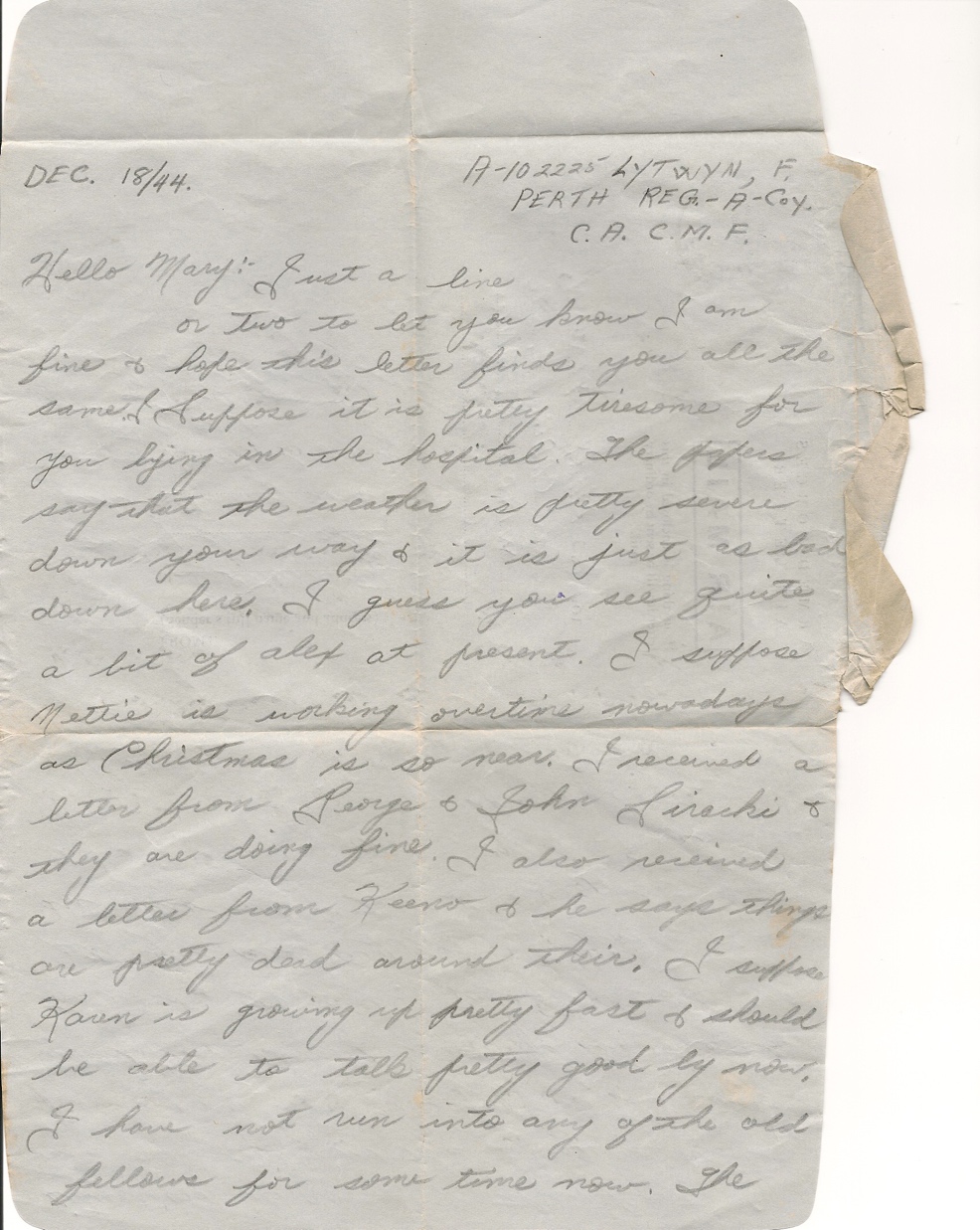
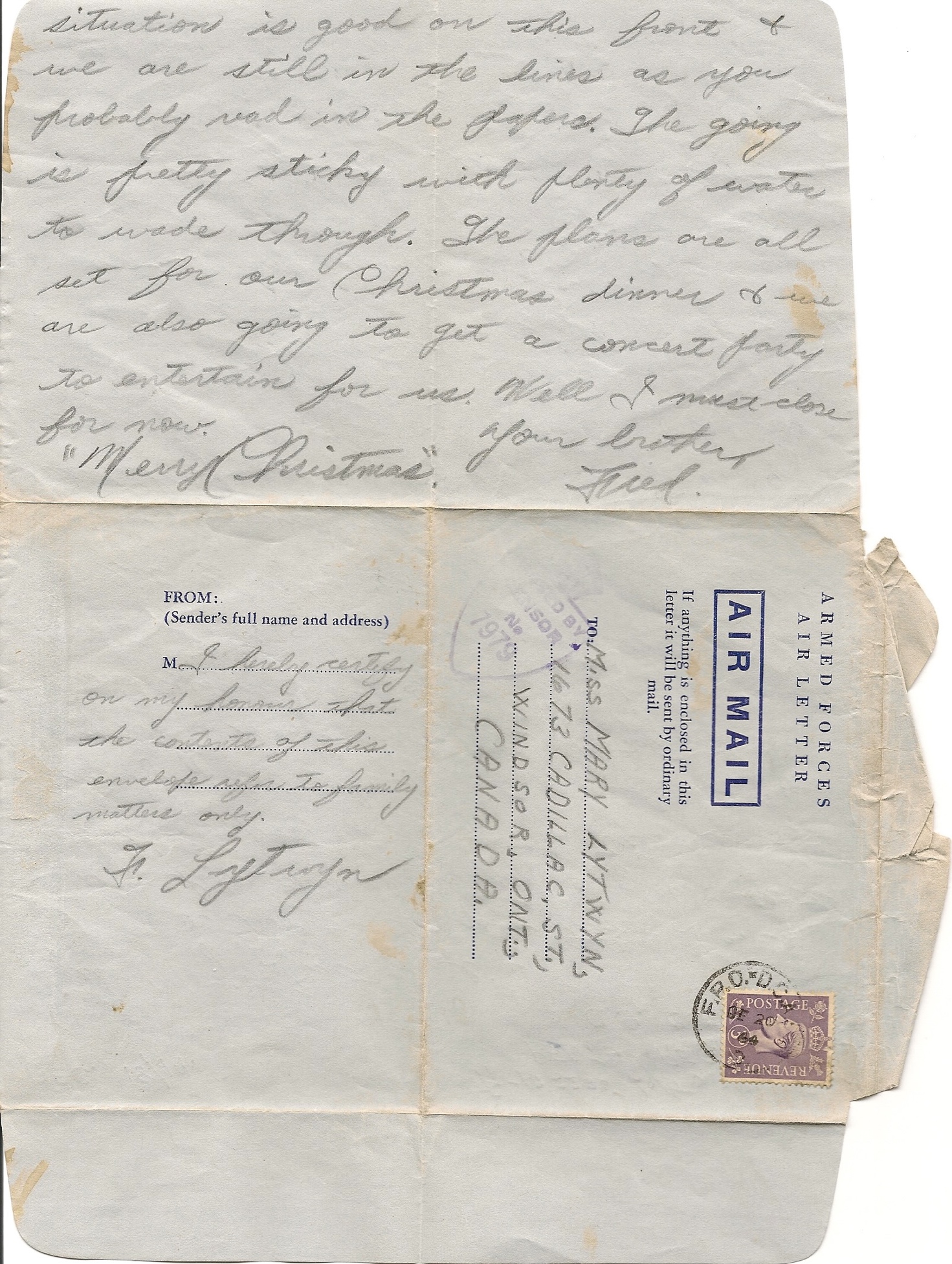
Here’s the last of the many letters written by Fred to his family in Canada. It is addressed to his sister Mary and dated December 18, 1944 – just two days before he gave his life in action at the Fosso Munio.